
Sovereign cloud
A sovereign cloud isn’t a product you switch on. It’s the control you have over where your data lives, who can reach it, and which laws apply. Azure Local gives you more of that control, but only when you design for it. We help you work out which layers you actually need, and show your auditor and your board that those choices meet NIS2.
What sovereignty actually means
Sovereignty gets used as a blanket term, but it's really several kinds of control, and they don't all move together. Location is where your workloads run and who controls the hardware. Data is who can actually read it; on Azure Local it stays on local storage with keys only you hold. Jurisdiction is the honest part: your data stays on-premises, but Microsoft is a US company and stays in the legal chain, so removing technical access is not the same as removing legal reach. Naming these layers separately is what makes the conversation with your auditor and your board an honest one.

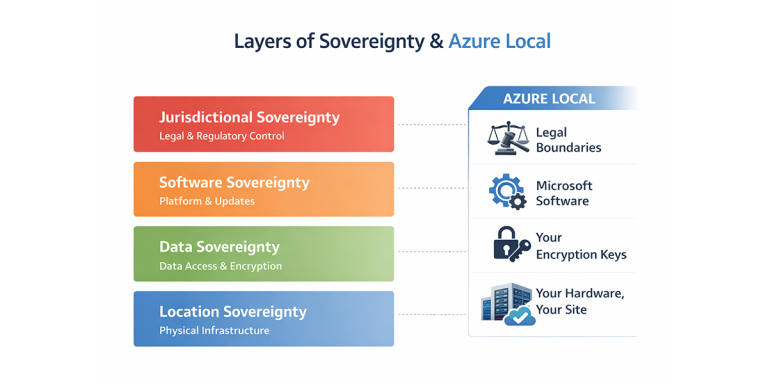

How we get sovereignty in order
We start by pinning down what sovereignty actually means for you. Location, data, jurisdiction, and software are separate layers of control, and they don’t all move together. We map your requirements against each layer, and we’re honest about the one nobody can design away: Microsoft stays in the legal chain. Then we design for the layers you need. Your workloads run on Azure Local in your own datacenter, with encryption keys only you hold, so without your keys, nobody can read your data. Desktops run on Azure Virtual Desktop, with sessions and data on your own hardware. Every choice is documented as evidence, so you can defend it to your auditor, to NIS2, and to the board. Curious what a project looks like? See our client cases.


Sector examples

Healthcare records
An academic hospital runs AI on patient data, on GPU in its own datacenter, so records never leave the building.

Manufacturing data
A manufacturer keeps OT and process data on site, with encryption keys only its own IT team holds.

Government sovereignty
A province combines sovereignty requirements with central management through Azure Arc.
Let’s talk it through
One conversation is usually enough to see where the value is for your organization, whether that’s in cost, risk, or everyday management. No slides required.

Other solutions we provide


What is a sovereign cloud?
A sovereign cloud gives you control over where your data lives, who can access it and which laws apply to it. It isn't one product you switch on: it's a set of choices about location, encryption, access and jurisdiction. How far you need to go depends on your sector and your regulators.

Is our data sovereign on Azure Local when Microsoft is a US company?
Your data is stored on your own hardware, in your own location, encrypted with keys you hold. That gives you strong technical control. Microsoft remains a US company in the legal chain, so technical control is not the same as removing legal reach. Whether that's sovereign enough depends on how you define sovereignty, and we help you make that definition explicit.
Who can read our data on Azure Local?
Only the people and systems you give access to. Data on Azure Local is stored on your own hardware and encrypted at rest, and you can hold the encryption keys yourself. Without those keys, nobody can read your data, Microsoft included.
How does this help with NIS2, ISO 27001, NEN 7510 or BIO audits?
Azure Local doesn't make you compliant by itself, but it makes your controls easier to prove. We document every design choice, from data location and encryption to access and update policy, as evidence you can hand to your auditor. That answers the questions these frameworks ask about where data lives and who controls it.
Which SEAL level does Azure Local reach under the EU Cloud Sovereignty Framework?
The EU Cloud Sovereignty Framework scores a cloud service on eight sovereignty objectives, each on a scale from SEAL-0 to SEAL-4. Where Azure Local lands depends on how it's set up and operated; in our assessment, a standard setup connected to Azure scores around SEAL-1 on most objectives. A disconnected setup with an EU-based operator, keys held only by you and logging in an EU SIEM can move several objectives toward SEAL-2, but the formal score comes from the assessment in each tender. SEAL-3 and SEAL-4 require EU control over the technology and its supply chain; in our view no mainstream enterprise platform offers that today.
What does it take to get Azure Local or Windows Server closer to SEAL-2?
It depends on the objective and on how the tender scores it, but the setups that come closest share four traits. There is no cloud control plane in scope: Azure Local with disconnected operations, or Windows Server 2025 with Hyper-V and Storage Spaces Direct. An EU company operates and supports the platform, only you hold the encryption keys, and logs go to an EU SIEM with an EU incident team. We help you design for those conditions and document them for the assessment.
What is Microsoft Sovereign Private Cloud, and how does it relate to Azure Local?
Microsoft Sovereign Private Cloud is Microsoft's offering for organizations that need to run critical workloads on hardware they control, up to fully disconnected environments. It's built on Azure Local, with Microsoft 365 Local and Microsoft's security tooling on top. As Azure Local specialists with two Microsoft MVPs on the team, we design, build and manage the foundation it runs on.
Can Azure Local run fully disconnected from the internet?
Yes. With disconnected operations, Azure Local runs without any connection to Azure, using a local control plane with its own Azure portal and command line. It's meant for sovereign, regulated or isolated sites and needs a dedicated management cluster on Premier Solutions hardware.
What's the difference between data sovereignty and data residency?
Data residency is about where your data is stored, for example in the Netherlands or the EU. Data sovereignty goes further: it's about which laws apply to that data and who can be forced to hand it over. You can meet residency requirements in a public cloud region; sovereignty also depends on who runs the infrastructure and holds the keys.
You deal directly with the people who build your platform
Splitbrain is small and specialized, with deep technical expertise. No handover from sales to delivery: the people who advise you also build your environment. Two Microsoft MVPs on the team, a title Microsoft reserves for proven experts. You work directly with the specialists who design and build your environment Microsoft partner Technology Experience Center: test with your own data before you invest.


More info



Navigation
Important links
Contact details
Socials

