Artificial Intelligence
Manufacturing and healthcare want to use AI, but sending production data or patient records to a public AI service raises questions that make most compliance officers stop the project before it starts. Where does the data go, who keeps the results, does the provider train on it? Our answer is an AI factory on Azure Local: inference on GPUs inside your own datacenter, so you get the AI value while your data stays where you put it.
Why AI belongs close to your data
Public AI services are strong for experiments and general use, but they get harder to defend the moment the input is sensitive. In manufacturing, process and OT data often can't leave the site, for latency and for control. In healthcare, patient images and genomic data can't go to a third party at all. When the data can't leave, the AI has to come to the data, and that changes where you run it.



How we build your AI factory
We start with the use case and the data, not the model. Where does the data live, what can leave the site, and what does the business actually need? From there we build the platform: GPU capacity on Azure Local in your own datacenter, with Azure Kubernetes Service to run the models in containers. Training can happen in the cloud; inference runs next to the machines, where latency and control matter. With Microsoft Foundry and Foundry Local you run current AI models entirely on your own hardware, under your own governance, so patient records and production data never leave the building. The whole environment is managed as code and monitored centrally, so your own team can run it after we hand it over.


Sector examples
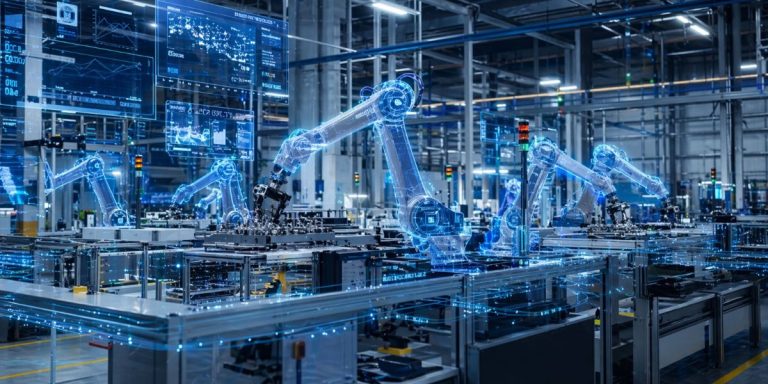
Manufacturing inspection
A factory runs quality inspection models next to the production line, with millisecond latency.

Healthcare imaging
A hospital analyzes medical images with AI while patient data stays inside the building.

Government documents
A government body runs language models on sensitive documents, on its own hardware.
Let’s talk it through
One conversation is usually enough to see where the value is for your organization, whether that’s in cost, risk, or everyday management. No slides required.

Other solutions we provide


Can we use AI without sending sensitive data to a public AI service?
Yes. With local AI, the models run on GPUs in your own datacenter, so prompts, data and results stay inside your network. We build this on Azure Local with Foundry Local, which runs current AI models on your own hardware under your own governance.

What hardware do we need to run AI models on-premises?
That depends on the use case. A model that answers questions about documents needs different GPU capacity than real-time image recognition on a production line. We size the GPUs to your use case and model, in servers that are supported for Azure Local.
Can we train in the cloud and run the model locally?
Yes. You can train or fine-tune a model in Azure, where large GPU capacity is available on demand, and then run it on your own hardware. Foundry Local on Azure Local lets you bring your own model, so inference happens next to your data and machines.
How do you keep latency low for AI on the shop floor?
By keeping the compute close to where the data is created. Inference runs on GPUs in your own datacenter or at the edge next to the machines, so there's no round trip to a cloud region. Response times stay low, and the AI keeps working if the internet connection drops.
Who owns our data and the results, and does anyone train on them?
With local AI, you do. The data, the prompts and the results stay on your hardware, and a model only learns from your data if you choose to train or fine-tune it yourself. With public AI services it depends on the provider's terms, which is why we recommend local AI for sensitive data.
You deal directly with the people who build your platform
Splitbrain is small and specialized, with deep technical expertise. No handover from sales to delivery: the people who advise you also build your environment. Two Microsoft MVPs on the team, a title Microsoft reserves for proven experts. You work directly with the specialists who design and build your environment Microsoft partner Technology Experience Center: test with your own data before you invest.


More info



Navigation
Important links
Contact details
Socials

